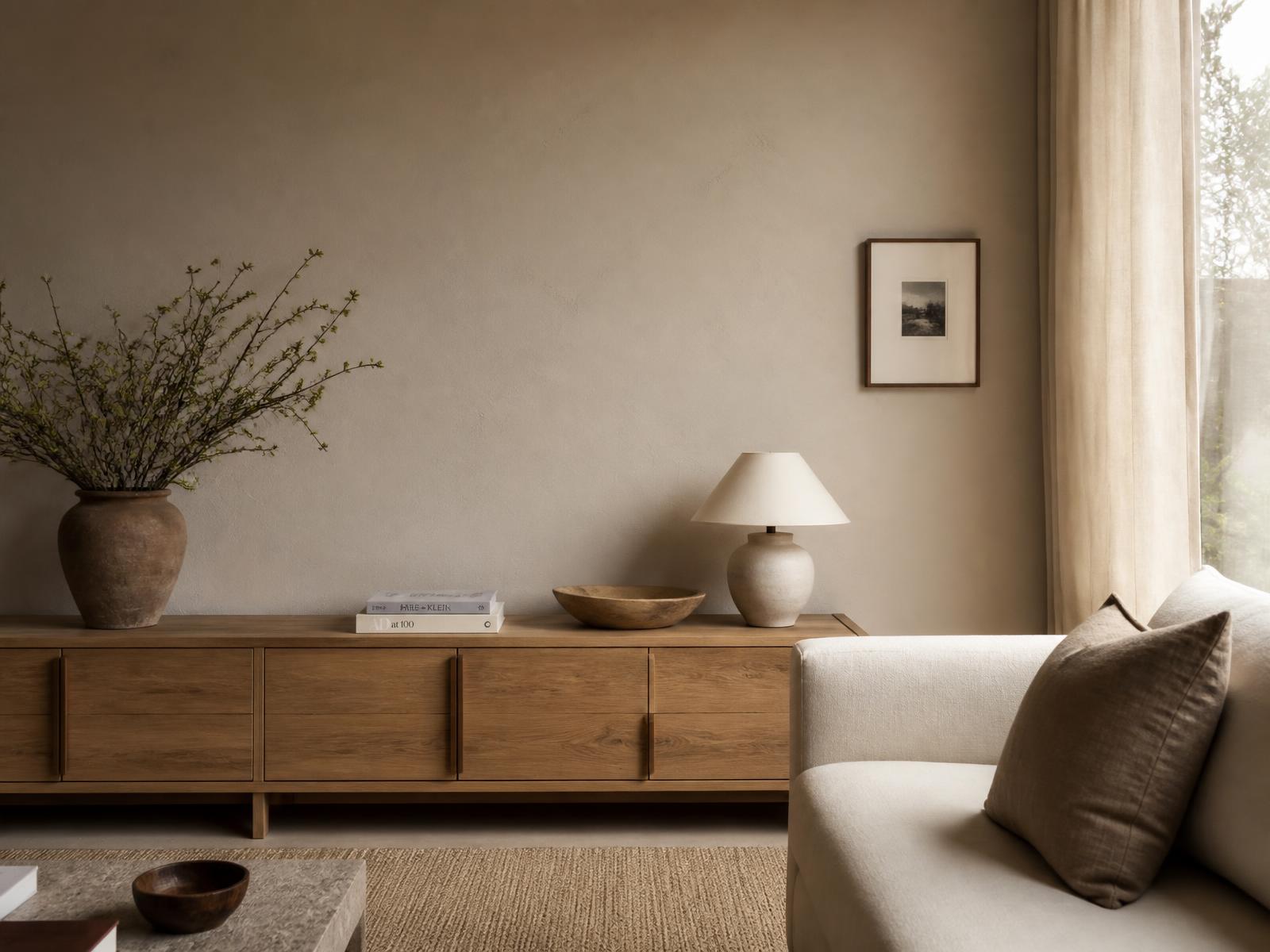
Is Peel and Stick Wallpaper Good Quality? How to Tell Before You Buy

Peel and stick wallpaper has a reputation problem. Ask around and someone will have a story about edges curling within a month, or a pattern that looked crisp online and fuzzy on the wall, or a panel that took a strip of paint with it on the way down.
Those stories are real. They just don't describe the whole category. Most of them trace back to cheap product, a wall that wasn't ready, or both. Good peel and stick on a sound wall stays put for years and comes off cleanly when you're done with it. The trick is telling the two apart before you've paid for a whole room.
So, is peel and stick wallpaper good quality?
It can be. Quality varies more in peel and stick than in almost any other wall finish, because it's easy to get into. Anyone can print a pattern onto adhesive film and sell it by the roll. What separates a good product from a forgettable one is mostly invisible in a product photo: the finish, the print, the adhesive, and how the panels are sized and joined.
A better product is also more forgiving to install. You can lift and reposition a panel while you're lining it up, and it sits flat instead of fighting you. That matters, because almost everyone putting up peel and stick is doing it themselves.
Six signs of good peel and stick wallpaper
1. A matte finish. Shine is the quickest giveaway of cheap vinyl. It catches light along every join and turns a texture design into a photo of a texture. A matte surface reads as paper or plaster, and it's kinder to walls that aren't perfectly flat because it doesn't bounce light across every dip. Every Luxe Walls design is printed with a matte finish using water-based inks. Look at a plaster design like Sand Plaster under side light and you'll see why it matters.
2. Print that holds up close. Stand about an arm's length from the wall, because that's how close you'll be every time you reach for the light switch. On low-grade product, fine lines go soft and flat colour shows faint banding. Texture designs suffer most. A linen or limewash look only works if the print carries the detail of the weave or the brushwork, which is why the linen collection and the plaster collection are the hardest test of any printer.
3. An adhesive that grips and still lets go. The adhesive has two jobs that pull against each other. It has to hold through an Australian summer, then release cleanly years later. Too weak and the edges lift. Too aggressive and it takes paint with it. Ask any seller what their warranty says about adhesion, not only about print faults.
4. Printed to your wall, not sold by the roll. Stock rolls make you trim, and trimming means the pattern lands wherever the roll happens to run out. Printing to size fixes that. Luxe Walls splits each wall into equal panels between 700mm and 900mm wide, so a 300cm wall becomes four panels of 76.1cm and the pattern sits evenly from one corner to the other. You also choose the pattern scale with a slider before you order, so a motif can be made bolder for a big living room wall or quieter for a narrow hallway.
5. Panels that overlap. Butt joins on thin film can open up as a house moves with the seasons. An overlap gives each join something to hold onto. Every Luxe Walls panel has a 15mm overlap built in, which keeps joins closed and means you aren't trying to line up two raw edges by eye.
6. A warranty you can actually claim on. "Fade resistant" is on nearly every listing. A written warranty is the version you can hold someone to. Luxe Walls wallpaper carries a 2-year warranty against fading and adhesion failure, alongside your rights under Australian Consumer Law, and print faults can be reported within 14 days of delivery.
Why peel and stick fails (usually it's the wall)
Even very good wallpaper can't fix a wall that isn't ready for it. These are the common culprits.
Fresh paint. Paint that's less than about four weeks old hasn't fully cured. The adhesive bonds to the soft top layer, and when the wallpaper comes off, the paint can come with it. If you've just repainted, wait.
Chalky or dusty paint. Old flat and low-sheen paints can turn powdery. Wipe the wall with a dark cloth. If colour comes off on the cloth, the wallpaper will be sticking to dust, not paint. Clean it, and spot-prime or seal if it's bad.
Heavy texture. Peel and stick needs a reasonably smooth surface to grip. Light orange-peel paint is usually fine. Rough render and heavy texture need preparing first, and our guide to wallpapering over textured walls covers how.
Water in the wrong place. Our wallpaper is suitable for well-ventilated bathrooms, powder rooms and laundries, not direct splash zones. Behind a basin with a fan running is a different job to a shower wall.
Rushed edges. Most lifting starts at a corner or a cut edge that never got pressed down properly. Smooth each panel from the centre out with a squeegee and go back over the edges firmly before you call it done.
How to test quality before you buy
Order a sample. A screen can't show you the finish, the adhesive or how a colour behaves in your light, and those are the three things you're trying to judge.
Luxe Walls samples cost $10 each, postage included. Each one is C5 size (162 x 229mm), printed on the actual peel and stick wallpaper, and the $10 is credited against a wallpaper order placed within 30 days. Allow around two weeks for it to arrive.
When it does, put it through its paces:
- Stick a sample up on the wall you're planning to cover, not a spare bit of board.
- Look at it in morning light and again at night under your own lamps.
- Check it side-on. Matte should stay matte, with no glare at an angle.
- Leave it a week, then lift a corner slowly. It should come away cleanly from sound, cured paint.
If you're deciding between two neutrals, order both. Warm beige and cool greige can look identical on a phone and nothing alike on a south-facing bedroom wall. Order your samples here.
What good peel and stick costs
Price isn't a perfect guide to quality, but very cheap product usually cuts corners somewhere you'll notice later. Luxe Walls wallpaper starts from $79/m², with artist collections at $99/m², and there's a 3m² minimum.
Here's how a typical feature wall works out. A wall 3.0m wide and 2.4m high is 7.2m². A 10% allowance takes that to 7.92m², which is charged to the next 0.1m², so 8.0m². At $79/m² that's $632, printed to size. Shipping is free on orders over $250 (a flat $49 below that), and Afterpay is available.
If you're after a softer, more tactile look on a budget, start in the texture collection and narrow down from there. Linen Stone is a good benchmark: a warm stone-and-taupe woven texture that shows off what a matte print can do on a bedroom feature wall.
For designers and trade
If you're specifying peel and stick for a client, the same checklist applies, with lead time added. Every order is printed to order with no stock held, dispatched within 5 to 7 business days and delivered 3 to 5 business days after that. It's a self-install product, so factor your own installer into the quote.
Approved trade accounts get $59/m² on the core range and $79/m² on artist collections (some licensed ranges excluded), with the same 3m² minimum. Apply for a trade account and order samples for client boards the same way.
Frequently asked questions
Explore Related Collections
Continue Reading
Can You Use Wallpaper in Bathrooms? An Australian Guide to Moisture-Smart Walls
Guides • 7 min read
How much does wallpaper cost in Australia?
Guides • 8 min read
Peel and Stick Wallpaper vs Traditional: Which Is Right for Your Home?
Guides • 5 min read
Can You Put Wallpaper in a Rental? Australian Tenancy Rules, State by State
Guides • 9 min read