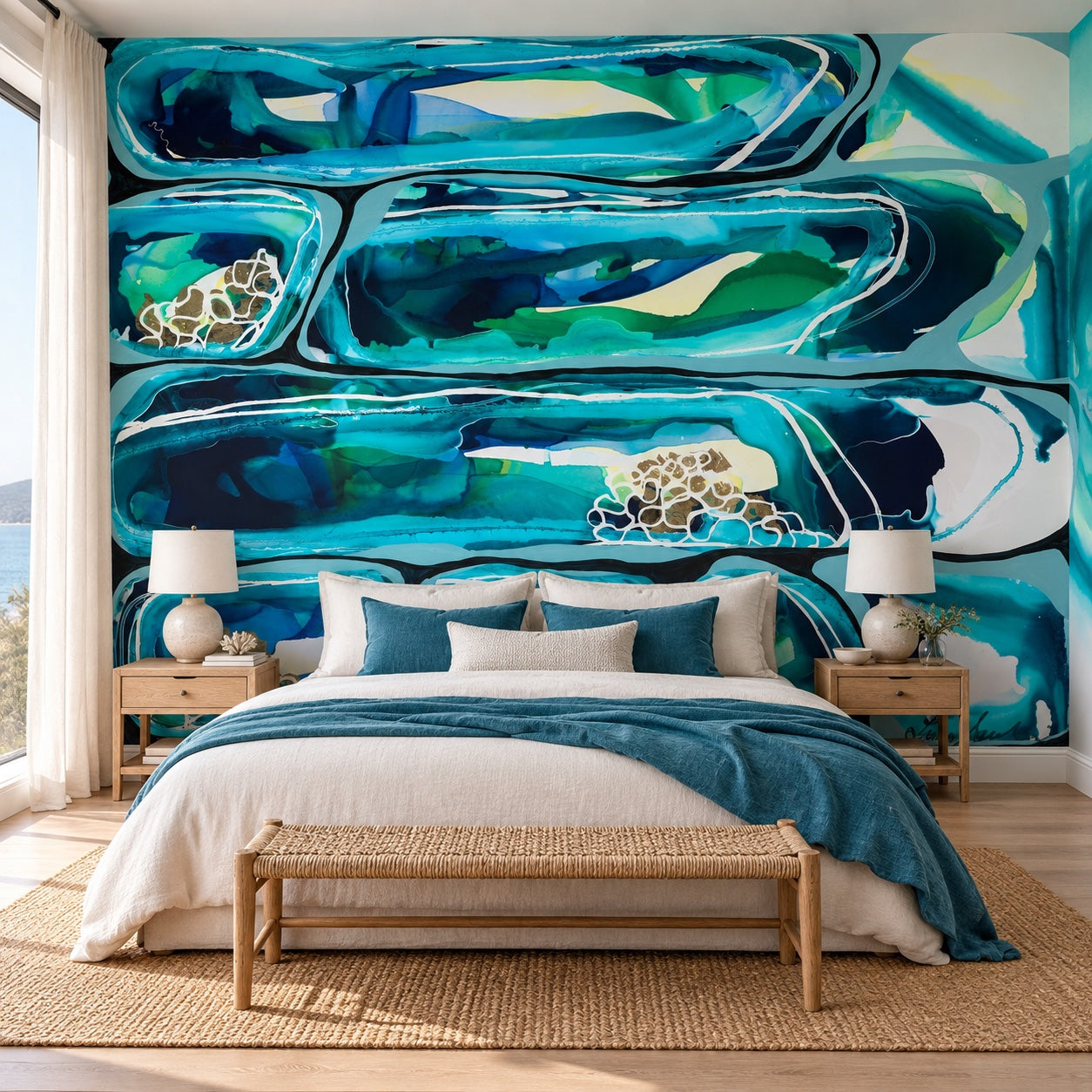
Wall Murals in Australia: How to Choose, Size and Hang a Peel and Stick Mural

A mural changes a room in a way patterned wallpaper doesn't. Instead of a motif repeating across the wall, you get one artwork, sized to that wall, with a beginning and an end. Done well, it reads like a painting that happens to be the full width of the room.
That also means the decisions are different. With a repeat, you mostly choose a pattern and a colour. With a mural, you're choosing a wall, an artwork, and which part of that artwork lands where. This guide walks through each one, then covers sizing, sampling and hanging it yourself.
What makes a mural different from wallpaper
Patterned wallpaper is built to tile. The design repeats every so many centimetres, so it doesn't much matter where a drop starts. A mural is a single composition. There's a horizon, a brightest point, a part of the picture your eye goes to first, and those need to sit in sensible places on your wall.
Every design in our murals collection is an original artwork by one of our artists, used under licence and printed to order. Lara Scolari's layered abstract paintings, De-Anne Strange's Western Australian bush and wildflower work and Alessandro Scanziani's painted scenes all start life as finished pieces of art. We print them to your measurements, so the composition is planned for your wall rather than cut off wherever a roll runs out.
Start with the wall, not the artwork
It's tempting to fall for a design first. Pick the wall first, because the wall decides how much of any artwork you'll actually see.
A good mural wall has a clear, mostly uninterrupted run, and you can see it from far enough back to take in the whole composition. Usually it's the wall your eye already goes to when you walk in.
In most Australian homes that means:
- Behind the sofa in a living room, where the mural becomes the backdrop to the whole space.
- Behind the bed, where the bedhead and side tables frame the lower part of the artwork.
- The long wall of a dining room, which you look at for an hour at a time across the table.
- The end wall of an entry, hallway or stairwell, where a mural gives the eye somewhere to land.
Walls broken up by doors, windows and a run of tall cabinets are harder. You can still use a mural there, but the openings will cut through the picture, so look for an artwork with no single focal point that would end up behind a door.
Note what's going in front of the wall, too. A sofa, bedhead or sideboard will cover the bottom third of the artwork. The part of the painting you most want to see should sit above that line.
Choosing the artwork
Once you know the wall, the artwork narrows itself down quickly. A few questions help.
How much movement does the room need? A living room you relax in can handle a lot of energy. Ocean Dance by Lara Scolari is a sweep of blues, teals and greens with the movement of water through it. It suits a wall you want to feel alive. If you love that style but want something calmer, Earth Echo I is the quietest of her works, in soft greys and browns with a hint of pink.
Abstract or a scene? Abstract work is forgiving on walls with interruptions, because there's no horizon to break. A painted scene, like Lake Como Mural in green by Alessandro Scanziani, gives a room a view, and works best on a clear wall where the whole picture can be seen.
What does the rest of the room look like? A mural is the loudest thing in a room, so let it lead and keep the other surfaces simple. Pull one or two colours from the artwork for cushions, a rug or a painted wall nearby. If your home leans towards native timbers and soft greens, De-Anne Strange's Under the Gum Tree sits naturally with them.
What's the light doing? In Australia, north-facing rooms get warm sun for much of the day and south-facing rooms stay cooler and flatter. The same artwork can look golden in one room and grey in another. That's the main reason to sample before you order, which we come to below.
Sizing a mural to your wall
This is where printing to order earns its keep. You give us your wall measurements and we print the mural to that size, so there are no stock rolls to trim and no half-used roll in the cupboard.
Measure carefully. Measure the width at the top, middle and bottom of the wall, and the height at both ends and the middle. Walls are rarely perfectly square, so use the largest figure for each.
We add the allowance. A 10% allowance is added automatically, which gives you room to trim at the ceiling, skirting and corners.
Panels are split evenly. Each wall is divided into equal panels between 700mm and 900mm wide, with a 15mm overlap built into every join. A 3m wall becomes four panels of 76.1cm, so the artwork runs evenly from one corner to the other and the joins stay closed.
Set the scale. When you order, you choose the scale of the design with a slider. For a mural, that's how you decide how large the artwork prints on your wall. A larger scale shows an enlarged section of the painting, which can be a lovely, more textural option in a smaller room. Think about where the focal point will land, such as the brightest part of a painting sitting above the sofa back rather than behind it.
Here's how a typical mural works out. A wall 3.0m wide and 2.4m high is 7.2m². The 10% allowance takes it to 7.92m², charged to the next 0.1m², so 8.0m². Murals are artist originals at $99/m², so that wall comes to $792.
Sample it on the wall first
A mural is a bigger decision than a small repeat, so look at it in your own light before committing.
Our samples are $10 each, postage included. Each one is A5 (148 x 209.4mm), printed on the actual peel and stick wallpaper, and the $10 is credited against a wallpaper order placed within 30 days. They arrive within 5 business days.
Stick the sample up on the wall you're planning to cover and leave it there for a few days. Check it first thing in the morning, in the middle of the day and at night under your lamps. If you're torn between two artworks, put both up side by side. Order your samples here.
Hanging a peel and stick mural
Our wallpaper is self-adhesive and designed for you to put up yourself. There's no paste and no soaking, and you can lift and reposition a panel while you line it up. You'll need a spirit level, a pencil, a smoothing tool or squeegee, a sharp blade and a step ladder.
Get the wall ready. Paint needs about four weeks to cure before anything sticks to it. Wipe the wall down, let it dry, and run a dark cloth over it. If colour comes off, the paint is chalky and needs cleaning and sealing first.
Then hang it in order:
- Lay the panels out in order on the floor so you can see the full artwork before anything goes up.
- Draw a plumb line with your level for the first panel. Don't trust the corner, because few corners are truly straight.
- Peel back the top of the backing on panel one, line it up with your pencil mark and leave the extra at the ceiling. Smooth from the centre out as you peel the rest of the backing away.
- Hang the next panel over the 15mm overlap, matching the artwork, and smooth it the same way. Keep going across the wall.
- Trim the top and bottom with a fresh blade, then go back over every edge and join firmly.
Most lifting starts at an edge that was never pressed down properly, so that last step matters. If you'd rather not hang it yourself, any handy person or wallpaper installer can do it.
Thinking about a mural in a wet area? Our wallpaper is suitable for well-ventilated bathrooms, powder rooms and laundries, not direct splash zones.
Price, delivery and warranty
Murals in our collection are artist originals at $99/m², and the rest of our range starts from $79/m². There's a 3m² minimum order. Shipping is free over $250 and a flat $49 below that, so in practice every mural ships free. Afterpay is available.
Everything is printed to order with no stock held. Orders are dispatched within 5 to 7 business days and delivered 3 to 5 business days after that. Your wallpaper is covered by a 2-year warranty against fading and adhesion failure, and print faults can be reported within 14 days of delivery.
For designers and trade
Murals are a strong fit for hospitality, workplaces and reception areas, where a single artwork can carry a space and the artist's story gives clients something to talk about. Because we print to the site's measurements, you can specify a mural for a particular wall and know how the composition will sit.
Approved trade accounts get $79/m² on artist collections and $59/m² on the core range, with the same 3m² minimum. Apply for a trade account and order samples for client boards the same way. It's a self-install product, so include your installer in the quote.
Find your mural
Browse the full murals collection, shortlist two or three, and stick the samples up on your wall. Living with them for a week will tell you more than any photo.
Frequently asked questions
Continue Reading
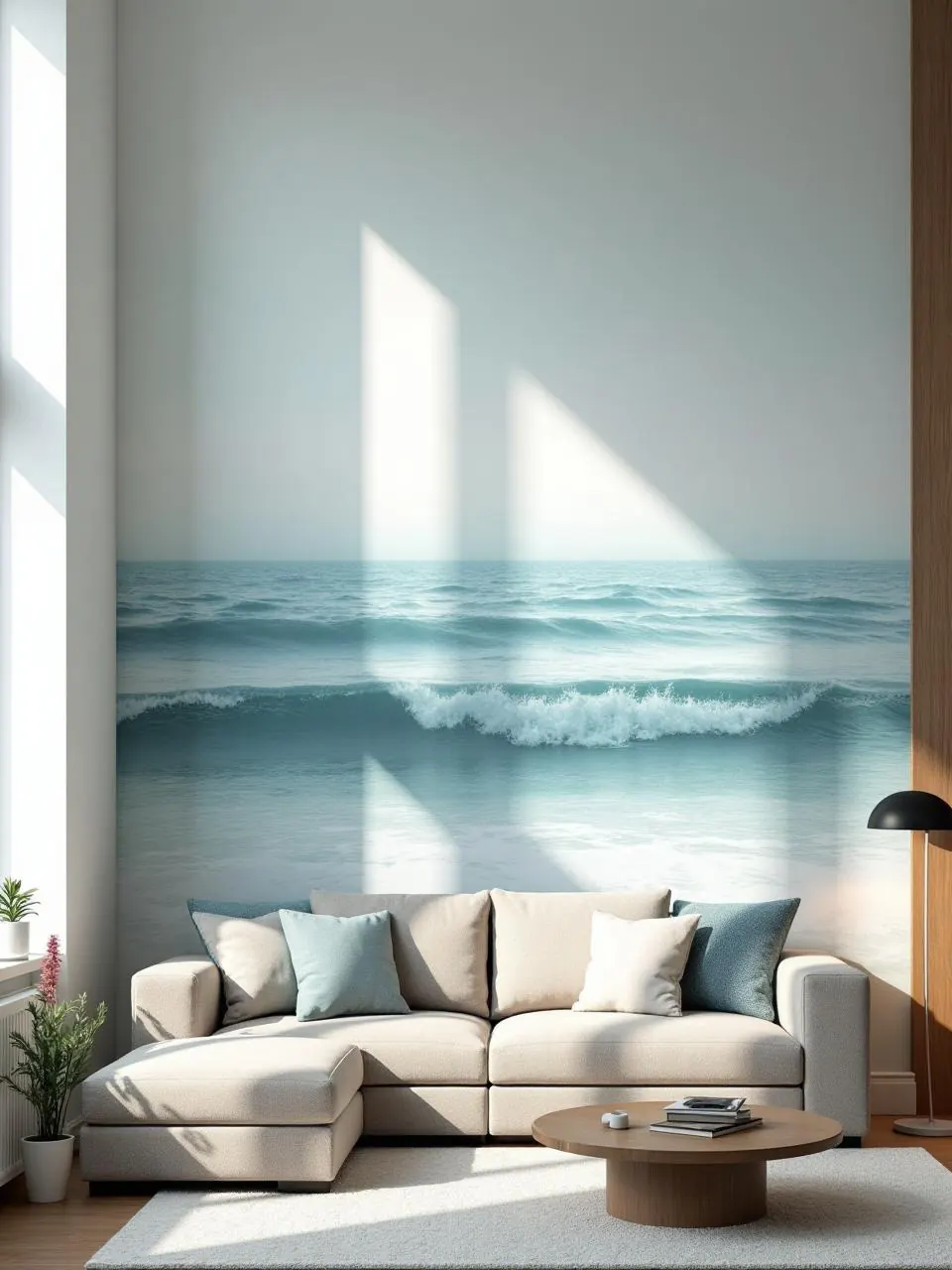
Can You Use Wallpaper in Bathrooms? An Australian Guide to Moisture-Smart Walls
Guides • 7 min read
How much does wallpaper cost in Australia?
Guides • 8 min read
Can You Put Wallpaper in a Rental? Australian Tenancy Rules, State by State
Guides • 9 min read

Is Peel and Stick Wallpaper Good Quality? How to Tell Before You Buy
Guides • 8 min read